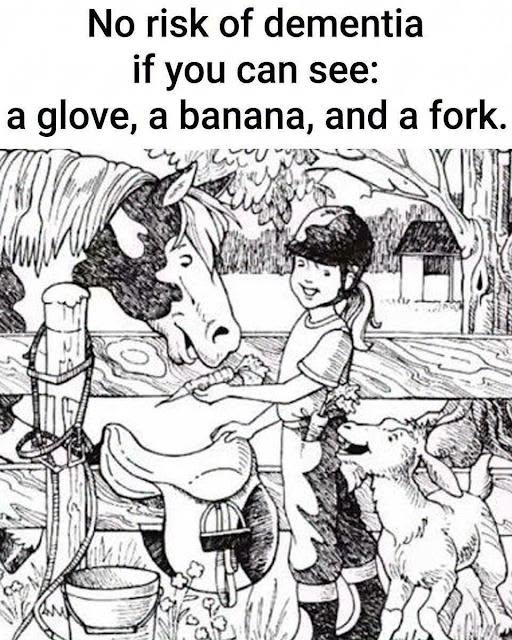
One reason these puzzles are entertaining is that our eyes do not examine every part of an image equally.
When looking at a complicated illustration, we naturally focus on prominent shapes, bright colors, and familiar patterns. Smaller details may receive less attention, even when they are right in front of us.
Hidden-object challenges take advantage of this natural tendency by placing familiar items among visually similar shapes.
For example, a banana might be difficult to recognize if its curved outline blends with another object. A fork could be hidden among several thin lines, while a glove might resemble part of a larger illustration.
The challenge is not necessarily about having perfect eyesight. It is about taking enough time to examine the picture carefully.
How to Find the Three Hidden Objects
If you are struggling to locate all three items, a systematic approach can make the search easier.
1. Divide the picture into sections
Instead of looking at the entire illustration at once, mentally divide it into smaller areas. Examine each section before moving to the next.
2. Search for distinctive outlines
Try to recognize the general shape of each object rather than focusing only on its color. A banana has a characteristic curve, while a fork usually has several narrow prongs.
3. Look beyond the obvious details
Some objects may be partially covered by other shapes or incorporated into the surrounding illustration. Pay attention to unusual outlines and small visual differences.
4. Take a short break
If you have been searching for several minutes without success, look away from the image briefly. Returning with fresh attention may help you notice details you previously missed.
A Fun Activity for Friends and Family
One of the best things about hidden-object puzzles is that they can be enjoyed together.
You can show the illustration to friends, family members, or colleagues and ask everyone to find the glove, banana, and fork. Some people may notice one object immediately, while others may discover a completely different detail first.
You can even turn the challenge into a friendly competition by giving everyone the same amount of time to search.
These activities are also suitable for family entertainment because they are simple to understand and do not require special equipment. All you need is the puzzle image and a little curiosity.
Do These Puzzles Improve Concentration?
Visual puzzles can provide an enjoyable opportunity to practise observation, attention, and visual recognition.
Searching for hidden objects encourages people to examine details, compare shapes, and remain focused on a specific task.
However, it is important not to treat a single puzzle as a scientific measurement of intelligence or memory. Finding the objects quickly does not necessarily mean someone is smarter than another person.
The real value comes from the enjoyment of solving the challenge and taking a few moments to engage with something different.
Did You Find All Three?
Now comes the most interesting question: were you able to locate the glove, banana, and fork without help?
If you found all three, congratulations! You successfully completed the challenge.
If one or more objects are still hiding from you, don’t give up too quickly. Look at the illustration again, examine the smaller details, and try approaching the search from a different direction.
Sometimes, the object we are searching for is hidden in a place we have already examined several times.
For Complete Cooking STEPS Please Head On Over To Next Page Or Open button (>)