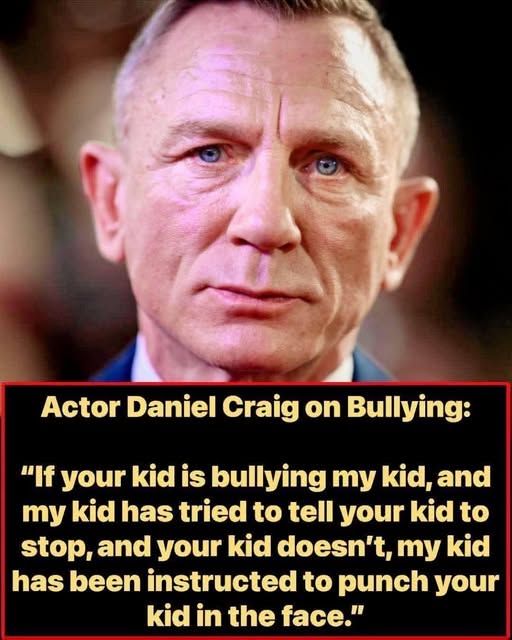
A few words can sometimes start an important conversation, especially when they touch on a subject that affects families everywhere. Recently, an image circulating online and attributed to British actor Daniel Craig has sparked discussion among parents about one of the most challenging issues children face: bullying.
The message suggests that children should not be expected to tolerate repeated mistreatment and should learn how to stand up for themselves. While some readers agree with the general idea of encouraging children to be confident and assertive, others worry that messages involving physical retaliation could send the wrong lesson.
There is one important detail to clarify: the exact wording in the viral image has not been independently verified as an authentic quotation from Daniel Craig. Therefore, it should not be presented as a confirmed statement by the actor.
Nevertheless, the discussion raises a genuine question worth exploring: How can parents help children respond to bullying in a safe, confident, and responsible way?
Why Bullying Remains a Major Concern for Parents
For most families, childhood should be a time of learning, friendship, discovery, and personal development. School and other social environments give children opportunities to build relationships, develop confidence, and understand how to interact with others.
Unfortunately, bullying can interfere with these experiences.
Bullying generally involves repeated unwanted aggressive behavior, often accompanied by an imbalance of power. It can take several forms, and not all of them are immediately visible to adults.
Some children experience physical intimidation, while others face repeated teasing, insults, social exclusion, embarrassing rumors, or hurtful messages through digital platforms.
These experiences can affect a child’s confidence and sense of security. A child who is repeatedly targeted may become reluctant to attend school, participate in activities, or spend time with classmates.
For this reason, parents should take reports of bullying seriously, even when the incidents might initially appear minor.
Understanding the Difference Between Confidence and Aggression
One of the central questions raised by the viral message is whether children should ever be encouraged to fight back.
The answer requires an important distinction.
Teaching children to stand up for themselves does not mean teaching them to respond aggressively. Confidence is about understanding personal boundaries, communicating clearly, and recognizing when a situation requires help.
Aggression, on the other hand, involves deliberately intimidating, threatening, or hurting another person.
Children should understand that they have the right to feel safe and that nobody should repeatedly mistreat them. At the same time, they should learn that physical retaliation is not a general solution to disagreements or bullying.
If a situation becomes physically dangerous, the priority should be getting away from the threat and reaching a trusted adult or appropriate authority. Any necessary protective action should focus on immediate safety rather than revenge.
This distinction can help children understand that being strong does not require being violent.
Recognizing the Different Forms of Bullying
For Complete Cooking STEPS Please Head On Over To Next Page Or Open button (>)