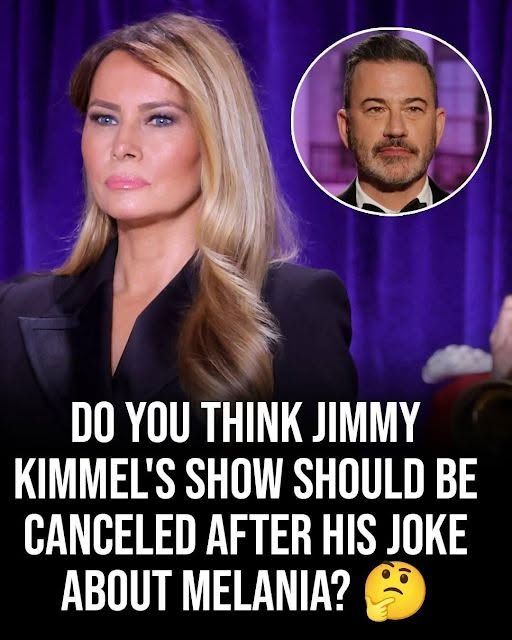
Following the controversy, Melania Trump expressed her frustration in a public social media statement.
She described Kimmel’s comments as harmful and accused the comedian of using rhetoric that contributes to division in American society.
She also questioned why ABC’s leadership continued to support the television host and called on the network to take a position.
In her statement, she referred to Kimmel as a “coward” and argued that his remarks went beyond ordinary political comedy.
Her comments quickly attracted attention from supporters and critics alike.
Some people agreed that jokes involving the possibility of a spouse’s death were inappropriate, particularly given the security incident that had recently taken place.
Others argued that political satire frequently involves uncomfortable subjects and that comedians should retain the freedom to criticize public officials without facing pressure to lose their jobs.
Donald Trump Also Calls for Action
Melania Trump’s criticism was followed by a public response from President Donald Trump.
He also called for ABC and its parent company, Disney, to dismiss Kimmel.
Trump described the comedian’s remarks as unacceptable and argued that the joke crossed an important boundary.
The president’s reaction added another dimension to the controversy, placing the network in the middle of a public disagreement involving political leaders and a prominent television personality.
The situation also renewed attention to previous disagreements between Trump and Kimmel, who has regularly used his late-night program to criticize the president and his administration.
Their relationship has been marked by repeated public exchanges, making the latest controversy part of a longer history of political tension surrounding late-night television.
How Jimmy Kimmel Responded
Kimmel addressed the criticism during his program on April 27.
He explained that the joke had been intended as a light political roast about the age difference between Donald and Melania Trump.
He rejected the suggestion that his comment was a call for violence or an encouragement of an attack against the president.
Kimmel also expressed sympathy for the people who had experienced the frightening events at the White House Correspondents’ Association dinner.
He acknowledged that the incident was traumatic while maintaining that his earlier joke had been misunderstood.
His response did not end the disagreement, but it provided additional context about how he intended the remark to be interpreted.
The exchange highlighted the difficulty of separating a comedian’s intended meaning from the way an audience receives a particular joke.
ABC and Disney Face Public Pressure
Because Jimmy Kimmel Live! is broadcast on ABC, the controversy placed the network and its parent company, Disney, under public scrutiny.
Melania and Donald Trump both called for the company to take action against the comedian.
The situation created a difficult question for network leadership.
On one hand, television companies must consider audience concerns, professional standards, and the consequences of controversial programming.
On the other hand, decisions involving political comedy can raise broader questions about editorial independence and freedom of expression.
At the time of the initial controversy, ABC had not publicly announced a decision to dismiss Kimmel.
The debate also attracted attention because of the network’s earlier experience with criticism involving the comedian.
In September 2025, ABC briefly suspended his program following backlash over comments he made concerning the killing of conservative activist Charlie Kirk. The program later returned to television.
These earlier events made the latest dispute particularly significant for the network.
The Debate Over Political Comedy
Political comedy has long been an important part of American television.
Late-night hosts frequently use satire to discuss elections, government decisions, public speeches, and the behavior of political leaders.
For supporters of this tradition, comedians should have considerable freedom to challenge powerful figures and make audiences think through humor.
They argue that satire does not always need to be comfortable or agreeable to be valuable.
However, critics believe that comedians also have a responsibility to consider the language they use, especially when discussing threats, violence, or the personal lives of public figures.
The disagreement over Kimmel’s joke reflects these competing perspectives.
Some viewers considered the remark an inappropriate personal attack. Others viewed it as a political joke that should be understood within the established tradition of late-night satire.
There is also an important distinction between criticizing a joke and calling for restrictions on someone’s ability to express an opinion.
A television network may receive public complaints about a comedian’s material, but any decision about programming can have wider implications for media independence.
Why Freedom of Expression Matters
The controversy has also renewed discussion about the importance of freedom of expression in a democratic society.
The ability to criticize elected officials, question public decisions, and use satire to examine political power is an important part of public debate.
Comedians, journalists, commentators, and ordinary citizens often express opinions that others may find uncomfortable or offensive.
At the same time, freedom of expression does not mean that every joke will be welcomed or protected from criticism.
People can disagree strongly with a comedian’s words while also recognizing the importance of allowing public discussion.
The challenge is finding a responsible balance between individual expression, professional judgment, and respectful public conversation.
The Kimmel controversy demonstrates how quickly that balance can become a subject of national attention.
The Role of Social Media in the Dispute
Social media played an important role in spreading the controversy.
Statements from Melania Trump and Donald Trump reached large audiences, while news organizations and television commentators discussed the comedian’s original remarks and his subsequent response.
Online reactions were divided.
Some users supported the First Lady’s criticism, while others defended Kimmel’s right to make political jokes.
The speed of online communication also made it easier for short quotations and emotional reactions to circulate without the full context of the original segment.
For readers following the story, examining the original remarks and the responses from the people involved is more useful than relying exclusively on shortened headlines or isolated social media posts.
A Disagreement That Raises Bigger Questions
The disagreement between Melania Trump and Jimmy Kimmel is about more than one controversial joke.
It reflects a broader debate about the relationship between entertainment, politics, media companies, and public responsibility.
Political figures are frequently the subjects of comedy, but jokes involving personal safety and family relationships can produce particularly strong reactions.
At the same time, calls for a broadcaster to remove a comedian can raise concerns about the independence of entertainment and media organizations.
There are no simple answers to every question raised by the controversy. People can reasonably disagree about whether the joke was appropriate while also recognizing that threats and political violence should never be encouraged.
Final Thoughts
Melania Trump’s criticism of Jimmy Kimmel brought renewed attention to the boundaries of political comedy and the responsibilities of television networks.
Her call for ABC to take action, Donald Trump’s demand that the comedian be dismissed, and Kimmel’s explanation created a public debate that reached far beyond a single late-night television segment.
The controversy illustrates how humor can become especially sensitive when political tensions are high and real-world security concerns are involved.
Ultimately, the discussion raises important questions about free expression, respect, and the role of satire in public life.
Whether viewers agree with Melania Trump’s response or support Kimmel’s defense, the episode serves as a reminder that political comedy can have a significant impact on public conversations, particularly when it involves powerful public figures.
For Complete Cooking STEPS Please Head On Over To Next Page Or Open button (>)